

Blood without representation
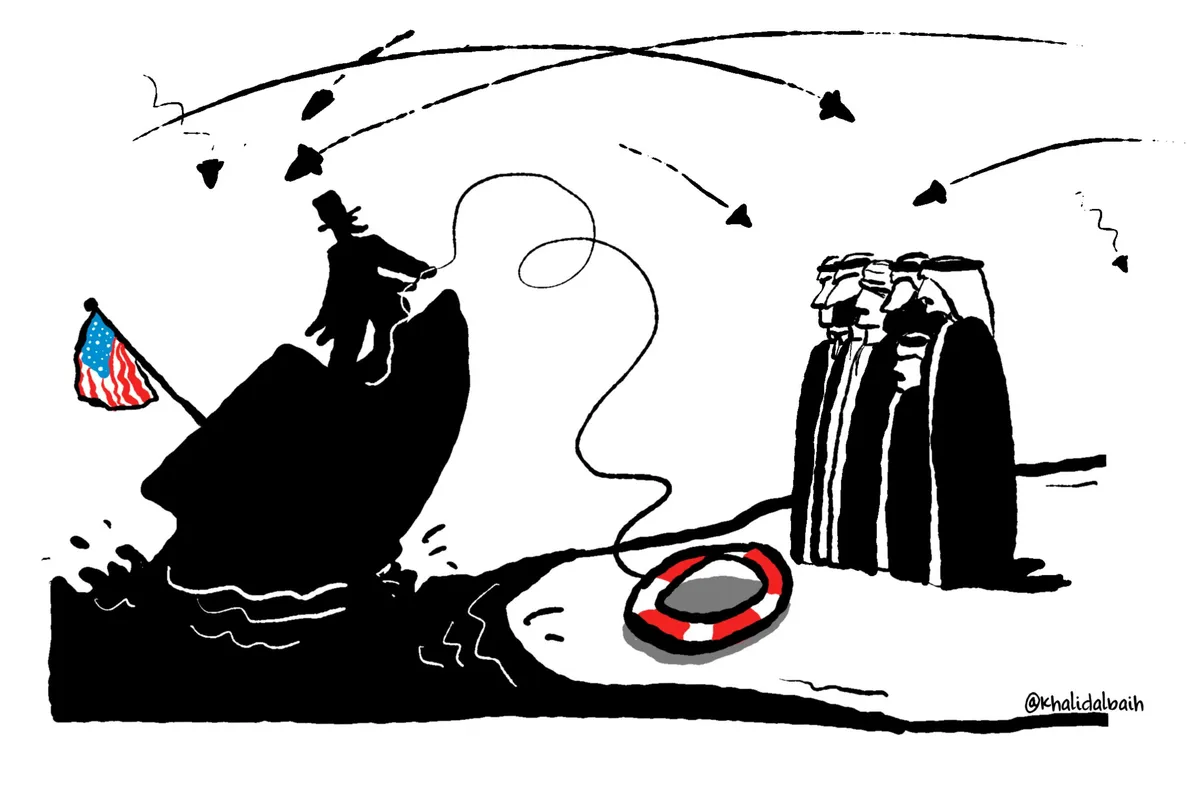
Why can’t Saudi Arabia, one of the world’s biggest military spenders, stop the Houthis? The answer isn’t just weapons. It’s the bargain the Gulf monarchies were built on, which is now breaking, and a decade of MBS’s absolute power that left the kingdom no way out.
Published 22 October 2026Saudi Arabia is one of the world’s biggest military spenders, yet this month, as Houthi missiles shut Riyadh’s main airport, it cannot reliably secure its own territory. Why?
Weapons, drones, doctrine and alliances all matter, but the real answer goes deeper than air defenses, training or generals. It goes to the kind of state Saudi Arabia is: why this military was built this way, why the kingdom can’t simply fight its way out, and why that threatens the Gulf’s future.
A model of statehood that sustained the Gulf monarchies for generations is under existential pressure. The crisis is happening now, before our eyes, and its roots go back much further than this war.
The analysis we present here applies across the Gulf, but Saudi Arabia makes the clearest case. Its decade under MBS was unusually dramatic, and it had perhaps the Gulf’s greatest chance to change course.
To understand what went wrong, we have to understand two bargains that made this whole political order possible.
The two bargains that built the Gulf
A state’s social contract is the foundation of its political order. It determines what rulers owe the citizens; what citizens owe the rulers; who has power; and what citizenship even means. The social contract sits even deeper than a constitution. Institutions, legitimacy, and political expectations are consequences of it.
The social contract of Gulf states can be viewed as being made up of two grand bargains: One is internal, between ruler and citizen; the other is external, between the state and the hegemonic power that protects it. These two bargains reinforce each other. Today both are shaking, and that is the heart of the crisis.
The Gulf countries are rentier states. In a rentier state, the state gets much of its income from external rents - in this case, oil - instead of taxing its people. Money arrives in the ruler’s hands first, then flows into society. That reversal shapes political power as profoundly as it shapes the economy.
Under the domestic bargain, citizens get jobs, benefits, infrastructure, prosperity and a share of the oil wealth. In return, they surrender political agency. The ruler decides the national future; citizens are expected to be loyal, grateful and quiet.
Over generations, this shapes what citizenship means. The citizen becomes a beneficiary of the state, rather than a participant in creating and governing it. And part of what the state promises to provide is security, including protection from the demands of prolonged war.
Gulf soldiers do serve, fight and die; this is no judgment about their patriotism. But a model built around providing comfort and security cannot easily demand years of mass mobilization and heavy casualties without endangering the bargain on which its legitimacy rests.
The external bargain follows from the domestic one: if the ruler promises security while avoiding the political costs of a mass national army, someone else must carry much of the burden. For decades, that someone was the US-led regional order and its immense military power.
These arrangements also help explain restricted citizenship; migrants form a majority of the population in most Gulf countries, but rarely enter the political community receiving the oil dividend. External protection reduces the need for a mass mobilization army, which would benefit from a larger population. And in the smaller monarchies especially, limiting the citizen population keeps that bargain affordable and the hierarchy intact.
But if you’re going to rely upon a powerful external protector to guarantee your security, how will you ensure that this power remains aligned with you? Gulf rulers didn’t merely sit under an American umbrella - they cultivated influence inside the protector’s system.
They did this through immense arms purchases, investment pledges, lucrative contracts, elite access, and relationships that look a lot like political “bribes”. Buying an expensive American weapons system strengthens your defenses, but it also purchases attention in Washington. Procurement becomes political insurance.
What serves the alliance, however, isn’t necessarily what builds an effective national army. This is why Saudi Arabia could buy world-class hardware without building an army capable of sustaining a prolonged war. Its defense model relied on imported systems and external backing, rather than organizing society for long-term national mobilization.
These are the two bargains that built the Gulf. Ultimately, the bargains interlock: external protection lets rulers avoid renegotiating citizenship, meanwhile the domestic bargain makes that protection indispensable. Take away the protector, and the problem stops being merely military; it becomes a question of what the state must be.
It was no secret that the Gulf states’ model can’t last forever. The domestic bargain requires oil, which is a finite resource; the external bargain assumes that the US remains both powerful and aligned. And while oil and US protection have endured for decades, neither is forever.
For generations, the reckoning felt so far in the future that nobody needed to worry about it.
The Arab Spring's unanswered question
In 2011, the “Arab Spring” threw open the question of who owns a country: Is it the rulers or its people? Millions across the Arabic-speaking region demanded political agency and a say in the future. Many were shot, tortured, imprisoned or killed for challenging old bargains.
Saudi Arabia did not have a revolution in 2011, but had its own, quieter opening. Its young, educated population built an extraordinarily lively public sphere, particularly on Twitter. Among those voices were many who, in the spirit of the Arab Spring, sought participation, political rights, accountability, and a say in the country’s future.
Most of these demands were not radical or revolutionary at all - but were quite moderate by regional standards. But they did open conversations about the foundations of the country’s political order and their sustainability.
The Arab Spring opened up some profound questions; there were two competing answers. Either, renegotiate the bargain with citizens as participants. Or, attempt to modernize society from above while keeping political power entirely in the ruler’s hands.
Among the many young Saudis on Twitter during these years was the then-25-year-old Muhammad bin Salman (MBS). He would become the most ambitious advocate of the second answer.
MBS's counterrevolutionary answer
MBS started off his career by saying something no Arab ruler had ever admitted: that Saudi Arabia’s economic model - the foundation of its domestic bargain - was unsustainable. He spoke with extraordinary urgency about the need for transformation. And he was right. But the answer he offered was very particular.
He set out to renegotiate the economic and social terms of the Saudi social contract, but he wanted to do so without granting any political rights. Under his vision of the renegotiated contract, citizens would work differently, earn differently, live differently, but the ruler would retain all political agency.
His plan had four interlocking parts. His regional vision emphasized decisive action against Iran and closer alignment with Israel. His political vision emphasized unprecedented personal control of the country; socially, he would champion top-down liberalization.
But arguably the cornerstone of his plan was a program of vast economic transformation. This package of reforms was, and still is, referred to as Vision 2030.
Regional moves. Post-2011, Netanyahu had a vision for an Israel-centered region: it involved a Gulf-Israel alliance against Iran, and the fostering of close economic integration and normalization with Arab states while sidelining the Palestinian cause.
Think of this as a real-estate master plan: The developer imagines the whole project, and others build within it. And MBS saw a place for his future, transformed Saudi Arabia within this regional vision.
MBS’s first post was that of Defense Minister. He argued that the country has traditionally been too cautious, and that direct, decisive military confrontation was necessary against Iran. He openly said that he wants to take the battle into Iranian territory.
In 2015, he launched a war against the Houthis in Yemen, arguing that they were supported by Iran. Most experts now agree that Iranian presence was very small, and that the Saudi intervention is actually what ended up opening the gates for Iranian involvement. The war on Yemen was meant to demonstrate a new, decisive Saudi Arabia; instead, it created a war the kingdom could not finish or walk away from.
Power consolidation. MBS broke older balances within the royal family and gathered economic and security power into his own hands. He justified this by arguing that reform was too urgent to tolerate obstruction or dissent.
MBS was, and still is, his own political agent; but two foreign powers greatly assisted in his power consolidation: the UAE and Israel. Jared Kushner became an important bridge between him, Netanyahu, and the first Trump White House.
With strong allies, MBS went on to change the order of royal succession to guarantee his position as Crown Prince. In 2017, he moved to destroy the Saudi public sphere we mentioned earlier: economists, religious reformers, activists, and writers were imprisoned in one fell swoop. Most are still in prison today.
Soon after, he orchestrated the now-infamous “Ritz-Carlton” incident, where he purged rival centers of wealth and influence in the country. In 2018, his agents murdered Jamal Khashoggi.
By the end of 2019, MBS was the singular, uncontested ruler of Saudi Arabia, having concentrated massive political, security, and economic control in his hands. His opponents were silenced, co-opted, imprisoned, or dead. Only a few managed to continue their work in exile.
Social liberalization. Before 2015, Saudi Arabia was unusually socially conservative, even by Gulf standards. MBS would loosen restrictions on entertainment, public life and women’s freedoms, bringing it closer to norms already familiar elsewhere in the Gulf.
These were meaningful changes, but they came exclusively as concessions from above. Citizens could enjoy freedoms handed down by the ruler, but couldn’t independently demand or “win” them. Women finally got the right to drive, but the activists who had fought for it for years were intimidated, imprisoned, and tortured.
Economic vision. MBS’s boldest promise was to end Saudi dependence on oil while simultaneously ensuring that the country remains just as prosperous. Replacing oil required an economic transformation vast enough to sustain the country’s future.
Hence NEOM, “The Line”, The Cube and the other fanciful megaprojects. (Note the geographical location of these projects, in the northern Red Sea conspicuously close to Egypt, Jordan, and Israel; the economic future, too, fit into that regional “master plan”.)
This isn’t to say that the economic transformation was only about the megaprojects; there were other important components. But the central promise was that Saudi Arabia would become oil-independent.
Remember, oil wasn’t just another source of government revenue - it financed the very social contract. MBS ultimately failed to deliver oil independence for Saudi Arabia, but an important question remains: suppose he succeeded. What would happen to the domestic bargain? To the social contract?
The Economist asked MBS in 2016 whether economic change required a new social contract and political representation. “One thing is not related to the other,” he replied. The government already represented the people.
Khashoggi, who supported reform, asked a different question: we know what the government wants, but what do citizens want? His 2016 series called for information and local participation.
The price of absolute power
Saudi Arabia had the best shot to renegotiate its social contract and become a country that can actually defend itself. A decade later, how did MBS’s wager turn out?
Begin with its central promise: an economy no longer dependent on oil. This was never just another development target - it meant replacing the economic foundation on which the Saudi social contract rested.
The megaprojects consumed staggering sums and had to be scaled back. The kingdom has spent $64 billion on NEOM alone, and NEOM’s budget to 2030 sets aside $16 billion just to cancel contracts there.
Non-oil GDP did grow, but Saudi Arabia still relies upon oil to finance the state. Saudi Arabia is still an oil rentier state; fossil fuel income still supplied 55 percent of government revenue in the first half of 2026.
What about the social changes? These changes were real: women driving, entertainment, less restrictive daily life. MBS managed to deliver these changes while keeping the social contract’s political core intact. But social changes were never a threat to the social contract in the first place.
What about political consolidation? Here, MBS succeeded spectacularly. But this is also where things get both interesting and tragic.
MBS monopolized power, crushed the independent public sphere, and made the country easier for one man to command. But this very success sabotaged the rest. He silenced economists, reformers, critics, and activists - and in doing so, destroyed the feedback and collective intelligence the country needs for actual transformation.
A ruler who tries to transform an entire country while destroying the people and institutions capable of challenging his judgment produces more than repression and injustice. The country progressively loses its ability to learn.
Transformation needs feedback: experts who can say “this won’t work”, citizens who can object, institutions that can correct course. MBS rewarded obedience and manufactured consensus. He gained the power to make decisions, but weakened the capacity to make good ones.
Imagine what Saudi Arabia could have built with even a fraction of that money invested in its people and productive institutions.
What about geopolitics? After his initial aggressive regional moves targeting Yemen and Qatar, MBS’s strategy actually shifted towards lowering the regional temperature in order to avoid war and focus on his economic agenda.
By 2021-2023, he was seeking some form of accommodation with Iran and the Houthis, as his alignment with the UAE (and Israel) frayed. And for a while, it worked, and relationships with Iran were improving, and a truce with the Houthis was holding.
But then came October 7th.
2026: when the bargains break
The October 7th attacks transformed Israel’s security outlook. Its earlier regional vision promised normalization and integration; its new logic increasingly treats open-ended war as the guarantee of security. We covered this transformation here.
That logic culminated in Israel drawing the US into war with Iran. This produced a stark divergence: Israel seeks security through confrontation; meanwhile Saudi Arabia needs stable borders, regional peace, and investors willing to bet on its post-oil future.
There’s tragic irony here: pro-Israel networks helped MBS consolidate power, and he imagined his future inside an Israel-centered regional master plan. But now, Israel’s wars threaten the security on which his entire project depends.
Gulf rulers had spent decades buying leverage within Washington: arms contracts, investments, favors and elite access. In this crisis they discovered that Israel could move American policy far more than they could. Their political insurance did not buy them a veto.
For Israel, there’s a sick strategic logic here: Iran and its allies are firing the missiles that hit the Gulf. Every attack pressures Gulf states toward the anti-Iran alignment Israel wants, even though Gulf rulers neither wanted nor chose this war.
But don’t mistake who fires the missiles for who drove this escalation. Before October 7th, Saudi Arabia had restored relations with Iran and was moving toward coexistence with the Houthis. It wasn’t peace, but accommodation was underway. Israel’s wars disrupted it.
What remains of the external bargain when the guarantor becomes the source of insecurity? The US can wage wars that expose the Gulf to retaliation, or retreat and leave them exposed. Either way, the protector no longer reliably provides the security the domestic bargain requires.
MBS’s legitimacy rests on Vision 2030: jobs, investment and a prosperous future beyond oil. That project depends on security. As the external bargain fails, the ruler’s promise to his own citizens becomes harder to deliver.
The US-led order hasn’t disappeared, and it can still wage devastating wars. But it is becoming less reliable as a protector, even while its actions expose Gulf states to retaliation. The power that was supposed to guarantee their security can itself generate insecurity.
So, is there a way out?
Can Riyadh return to accommodation with the Houthis? It was trying. But the Houthis now operate within the wider Iran-Israel war, and Riyadh does not control either side’s escalation. Its ports and oil facilities are exposed to the escalation, but it does not control who escalates and where.
Can new protectors fill the gap? The Mecca Pact, Turkey, Egypt, Pakistan: these ties can provide some forms of deterrence, diplomatic weight and military cooperation. But none is an army Riyadh can command into a prolonged, bloody war. It is not a replacement for national defense.
Then what would work? Only this: building the capacity to defend Saudi Arabia independently, for as long as necessary. That means national mobilization: soldiers, institutions, public trust, collective sacrifice. Not just purchasing hardware or hiring a new protector.
But that is exactly what the rentier bargain helped rulers avoid. If citizens must now serve, suffer casualties and send their children to war, they can demand a say in the decisions that risk their lives.
That was precisely the renegotiation MBS refused. The capacities needed to defend Saudi Arabia’s national transformation are the ones his political project suppressed. He spent a decade trying to prevent a new social contract. Now a new social contract may be necessary to save his project.
The future they cannot buy
The Gulf states need to develop an independent national defense capacity. This would mean a new relationship between citizen and state: who serves, who sacrifices, and who has a say in the decisions that put lives at risk.
But who will negotiate this transformation? Gulf rulers spent years suppressing political participation and independent organization, and built institutions to prevent precisely such renegotiations, while weakening the capacities needed to conduct them peacefully.
Saudi Arabia had perhaps the best chance: immense wealth, an educated young population, and time to build a different future. Instead MBS crushed much of that possibility. Think of Khashoggi, the lost decade, the wasted resources, and the institutions and futures that never got a chance to exist.
I don’t believe most Gulf rulers are capable of managing this peacefully. I really, really hope that at least some of them can. Refusing to change leaves their countries exposed to potentially existential threats. After generations spent avoiding this transformation, they now face it under some of the worst imaginable conditions.
None of the underlying danger was unforeseeable. Jane Kinninmont, then at Chatham House, warned in 2017 against deferring political reform until crisis forced it. We made related arguments then too, in the first episodes of the Arab Tyrant Manual podcast. The true cost was the lost decade of national capacity. And now the crisis has arrived.
It all goes back to the Arab Spring. Its central question was: who owns our countries’ futures? MBS offered the counterrevolutionary answer: a ruler can deliver national renewal without political rights. Look where that answer has led.
This piece opens several doors. Next we will cover the Iran war and the post-US regional order, Yemen, Israel, the UAE, and what comes after this Gulf model. Share and support Kulna if you want to explore them with us.