How Gaza broke the world-system
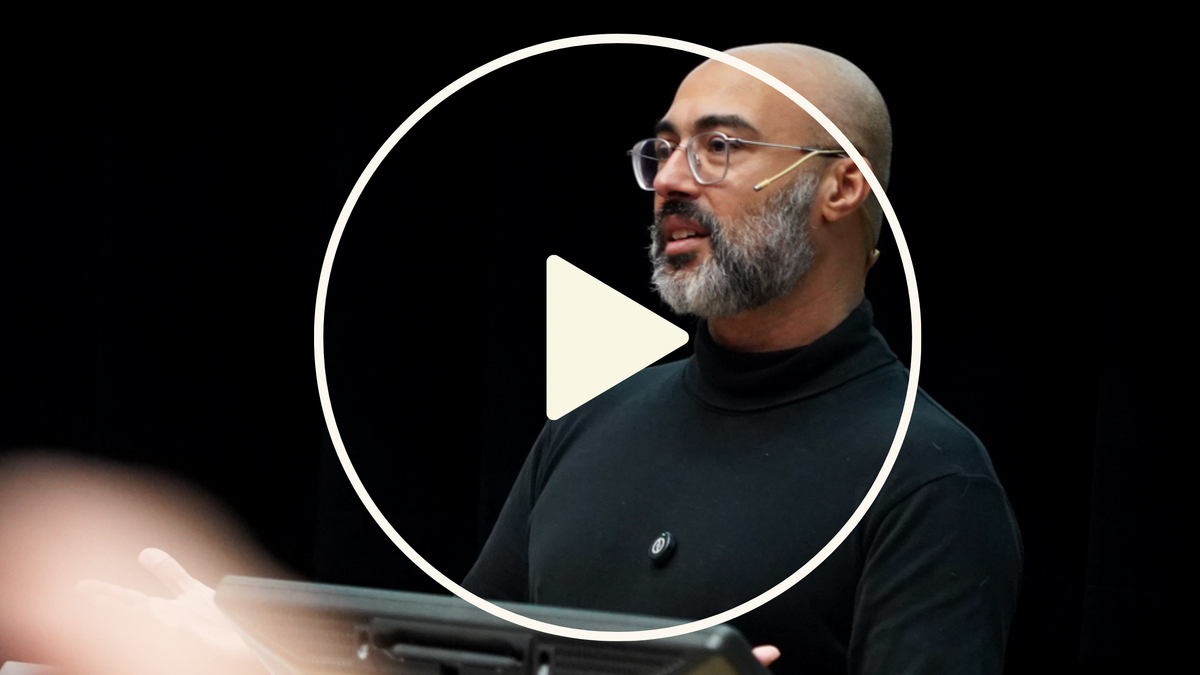
What does it mean when a system commits genocide? This lecture, delivered by Iyad El-Baghdadi at the University of Oslo on Tuesday, October 21, 2025, argues that the war on Gaza is not only a political rupture but a paradigm-breaking moment.

What does it mean when a system commits genocide?
This lecture, delivered by Iyad El-Baghdadi at the University of Oslo on Tuesday, October 21, 2025, argues that the war on Gaza is not only a political rupture but a paradigm-breaking moment - one that exposes the deep structures of the current world-system and signals its collapse.
Drawing on frameworks from Ibn Khaldun to contemporary systems theory, Iyad explores how to read this moment, locate ourselves within a generational shift, and begin the work of building what comes next.
Chapters
- 00:00 Introduction
- 08:24 First topic
- 22:10 Second topic
Transcript
Gaza and the Collapse of the World-System
Speaker: Iyad El-Baghdadi (President, Kawaakibi Foundation)Host / Venue: University of Oslo (Middle Eastern Studies / Political Science Seminar)Date Published: October 23, 2025
Executive Summary & Analytical Overview
Iyad El-Baghdadi examines the ongoing genocide in Gaza not as an isolated regional conflict, but as a terminal systemic shock to the post-1945 Western-dominated world-system. Grounded in a cyclical philosophy of history and systems theory, the lecture unpacks how world orders emerge, peak, decay, and collapse across generational timescales (75–90 years).
Core Theoretical Pillars:
- Models of Time: Contrasting modern Western linear progression and religious/ideological teleology against the cyclical/rhythmic model of history (encoded in the Arabic root of Dawlah / دولة, meaning that which circulates and turns).
- Lifecycle of Systems: Paradigms progress through seven distinct phases: Emergence → Rapid Consolidation → Peak → Decay of Built-in Contradictions → Breakage → Limbo → Paradigm Shift.
- The Six Universal Systemic Functions: Every enduring system (from a biological cell to a nation-state to the global order) must fulfill six functions: Boundary, Provisioning, Control, Cohesion, Epistemic sensing, and Continuity/Legacy. Currently, all six functions of the global order are in simultaneous acute crisis.
- Hierarchy vs. Natural Inequity Aversion: Hierarchy requires artificial scaffolding (justifying mythologies, structural violence, and psychological shame) to override the innate biological aversion to inequality observed across mammalian species.
- Israel as the Exceptional Space: The post-1945 Western order absolved its colonial and fascist history by constructing Israel as an exceptional sovereign space exempt from international norms. The Gaza genocide now exposes the entire system's moral and legal bankruptcy.
- Four Responses in Limbo: During the interregnum between broken and emerging systems, societies produce four behavioral archetypes: Reactionaries (accelerators of crisis seeking an impossible past), Nihilists (aiming to burn the system down), Centrists (in denial, defending an indefensible status quo), and Visionaries (systems architects designing the replacement order).
- Three Tiers of Time: Distinguishing Cosmological Time (millennia), Historical Time (generations), and Political Time (daily/weekly news cycle), urging organizers and intellectuals to operate in historical time rather than remaining captive to algorithmic political churn.
- Collective Liberation (Kulluna / كلنا): Framing Palestinian resistance not merely as a localized nationalist struggle, but as a universal catalyst for dismantling global hierarchies in pursuit of collective liberation for all.
Complete Lecture Transcription
Chapter I: Introduction & Framing the Lecture [00:00:02 – 00:03:31]
Iyad El-Baghdadi:I think we're good to start. Before we start, I just want to get a sense of the audience—the people in the room. How many here are students in the university? Just by a show of hands. How many of you are doing Middle Eastern studies or political science? Almost everybody. How many are Palestinian, Arab, or of Arab background?
Okay. It's not very often that we get to hear Palestinians speak about the world-system. A lot of the time, either we are not platformed or we are spoken about without really being given the microphone, or we are only presented to speak about our pain, our trauma, and our victimization. This is a different kind of lecture, because we will be talking about how Gaza is really changing the world. We're going to zoom out to speak about very long historical arcs.
The news media generally operates on a very fast cycle where, within a single week, you have already forgotten last week's news. It is very disorienting and confusing; it makes it easy to lose sight of where you actually are in history.
This is the structure of our seminar today. It is a straightforward framework because we want to examine the world-system and how it is transforming. We have two core parts, but speaking about them purely theoretically might feel too dry. Let's face it: even people who are not Palestinian are feeling the profound heaviness of what is happening in the world. I thought we should pace ourselves differently, alternating between discussing systemic models and the reality of systems change.
This is the question on everybody's mind—certainly on my mind and the minds of people around me: Everything we have done in our lives over the past two years has been happening against the backdrop of genocide. This is not normal. Sometimes you have to ask what "normal" even means, or whether we have lost our reference point for normalcy. It has been two years of relentless moral injury and acute feelings of betrayal. You have to ask: Where does this end? Where is this taking us?
That was one of the first questions I asked immediately after October 7th, witnessing the massive explosion of dehumanization directed at Palestinians: Where is this taking the world? Living in a Western-dominated world-system, we often fail to notice the inherited conceptual frames we take for granted without questioning them, forgetting that other cultures throughout history have viewed time and reality in fundamentally different ways.
Chapter II: Three Models of Time: Cyclical, Linear, and Teleological [00:03:31 – 00:06:50]
Iyad El-Baghdadi:Let's begin by discussing time itself, and how we conceptualize history.
Living in a Western-dominated modern world, we are accustomed to linear time—the presumption that history progresses continuously, where the past is inherently primitive and the future is inevitably more evolved or progressive. This is by no means the only way to understand time. I want to offer three distinct models of temporality:
- Cyclical (Rhythmic) Time:For most of human history, cultures understood time in cyclical terms because humanity lived in closer proximity to the natural world. People observed the daily rhythm of the sun, the monthly cycle of the moon, and the annual rotation of the seasons. It was natural to conceptualize human societies in recurring generational and civilizational cycles. Ancient Greeks thought this way, as did Islamic and Middle Eastern civilizations.
Western interpretations often misread cyclical concepts. For instance, when the media sensationalized the Mayan calendar around 2012 as predicting the "end of the world," they were superimposing a Western apocalyptic lens onto what was simply the completion of a major temporal cycle. Cyclical time encodes humility regarding human institutions.
A telling linguistic example is found in the Arabic language. The Arabic word for a state (as in a nation-state like Norway) is Dawlah (دولة). Its linguistic root, d-w-l (د-و-ل), literally signifies that which rotates, circulates, and alternates. This is the conceptual opposite of the Western term "state" (derived from Latin status), which implies stasis, permanence, and unchanging stability. Language itself preserves these divergent civilizational paradigms.
- Progressive (Linear) Time:Characteristic of Western modernity and institutional legacy. Having historical touchstones like the Roman Empire (which endured for over two millennia), Western thought often adopts the presumption that certain institutions and paradigms are designed to last indefinitely.
- Teleological (Messianic) Time:The belief that history is moving toward an ultimate culmination or salvation, often requiring a period of inevitable suffering. We see this structure across diverse ideological systems:
- Marxist-Leninist Communism: Historical materialism culminating in the stateless communist society as the "end of history."
- Liberal Triumphalism: Francis Fukuyama's framing of Western liberal democracy as the final form of human governance.
- Religious Messianism: Millenarian Christian and Messianic Zionist eschatology.
- Techno-optimism / AI Discourse: The contemporary narrative arguing that societies must endure current technological disruption and displacement because "Artificial General Intelligence (AGI)" and ultimate technological salvation are imminent.
Chapter III: The Lifecycle of World-Systems [00:06:50 – 00:10:45]
Iyad El-Baghdadi:In rhythmic and cyclical time, every paradigm and world-system undergoes a predictable, seven-stage trajectory:
Emergence ──> Consolidation ──> Peak ──> Decay ──> Breakage ──> Limbo ──> Shift
- Emergence:A new paradigm emerges directly out of the unresolved contradictions, crises, and explanatory failures of the preceding cycle. Emergence is never a single unified path; it begins as an intense competition among rival alternative systems.
- Consolidation:When a system successfully answers the pressing questions and operational needs of its era (not necessarily because it is morally superior, but because it is structurally fit for the historical moment), it consolidates with astonishing speed. It acts like someone selling water to runners who just finished a grueling marathon: because there is an overwhelming systemic thirst for order, institutions adopt it rapidly.
- Peak:The system achieves broad normalization and global hegemony, appearing permanent and natural. However, every system is born with inherent structural contradictions—analogous to "congenital birth defects." As the system expands, these contradictions do not heal; they grow proportionally larger alongside the system itself.
- Decay:Past the peak, contradictions expand to the point of generating persistent, compounding crises. Exceptional spaces and institutional workarounds multiply, accelerating institutional rot.
- Breakage:The moment when the system can no longer fulfill its foundational promises and stops functioning for the general population. Note that for marginalized populations locked outside the core, the system never functioned; their early warnings were simply ignored while the majority benefited. Breakage occurs when the failure becomes systemic and generalized.
- Limbo (Interregnum):The dangerous historical period where the old order has broken down, but the replacement system has not yet consolidated. This crisis phase can endure for a generation (several decades) and is marked by profound instability.
- Shift:A new coherent paradigm takes root, fulfilling the unanswered structural demands, and initiates the next macro-cycle.
Chapter IV: Generational Dynamics and Positionality [00:10:45 – 00:14:02]
Iyad El-Baghdadi:At any given moment, three distinct generations coexist: children entering the world, mid-career adults stewarding institutions, and elders completing their lifecycle. A sociological generation spans approximately 25 to 40 years of effective institutional agency. Consequently, the complete churn of three successive generations encompasses roughly 75 to 90 years—the natural lifespan of a macro-systemic cycle.
- Born in the 1940s–1960s: Entered during the post-WWII consolidation phase, spending careers refining and building upon an expanding, optimistic institutional architecture.
- Born in the 1970s: Entered near the peak of the system, observing the initial signs of decay and emerging contradictions.
- Born in the 1990s–2000s: Entering during the breakage and limbo phase, inheriting an exhausted order and bearing the responsibility of designing the successor architecture.
The Impact of Positionality
Your structural position relative to power dramatically alters when you perceive systemic failure:
- As a stateless Palestinian refugee born into diaspora, the post-1948 world order never functioned for me. The 1948 Nakba occurred concurrently with the founding of this post-WWII world-system. Marginalized populations recognize systemic breakage decades before the core does.
- Today, at Palestine solidarity demonstrations across Norway and globally, the overwhelming majority of participants are not Palestinian, Arab, or Muslim—they represent ordinary citizens across all demographics. This widespread mobilization proves that awareness of systemic breakage is no longer confined to the periphery; it has permeated the global mainstream.
Chapter V: The Anatomy of a System: Six Universal Functions [00:14:02 – 00:17:31]
Iyad El-Baghdadi:Systems are defined by complexity, specific function, and temporal endurance. Every enduring system exhibits a fractal architecture across scales—whether observing a single biological cell, a modern university, or the global world-system.
Chapter VI: Structural Hierarchy, Inequity Aversion, and Social Control [00:17:31 – 00:23:50]
Iyad El-Baghdadi:To analyze systemic change, we must shift our vocabulary from interpersonal interactions to structural dynamics:
- Private prejudice/bigotry becomes systemic racism when encoded into law and institutions.
- Interpersonal misogyny becomes structural patriarchy.
- Direct physical violence corresponds to structural violence (systemic deprivation, legal disenfranchisement, and institutional harm).
- Individual resource differences manifest as structural hierarchy.
The Parable of the Elephant and the Global Caste System
In the classic parable of the blind men touching different parts of an elephant (mistaking the tusk for a spear, the leg for a wall, and the trunk for a snake), each observer perceives only a fragment of the whole. Similarly:
- Capitalism requires an underclass forced to sell labor to survive; it cannot function if everyone possesses self-sufficient capital.
- Colonialism requires a subordinate periphery extracted to enrich the metropole.
- Neocolonialism maintains global debt relations, positioning the Global North as systemic creditors and the Global South as indebted resource suppliers.
- Racialized Patriarchy ranks human worth across racial and gendered lines.
Together, these forces constitute a single unified Global Caste System. The system provides just enough token upward mobility to sustain the illusion of meritocracy, but not enough to threaten the underlying hierarchy.
Inequity Aversion & The Triad of Hierarchy
Equality is the biological baseline for social animals. In famous primatological experiments conducted by Frans de Waal and Sarah Brosnan (2003), capuchin monkeys exhibited acute "inequity aversion"—violently rejecting cucumbers when observing a peer receive grapes for identical tasks. This innate rejection of unfairness exists across mammalian and avian species.
Because equality is our evolutionary baseline, constructing and maintaining an artificial hierarchy requires three structural pillars:
- Justifying Mythologies: Ideological narratives that explain why some groups deserve privilege while others must endure subjugation.
- Structural Violence: Systematic enforcement and deprivation to suppress resistance.
- Psychological Shame: Social and psychological conditioning that induces marginalized groups to internalize culpability for their disenfranchisement.
Chapter VII: Historical Milestones of the Current World-System (1945–Present) [00:23:50 – 00:26:24]
Iyad El-Baghdadi:The current world-system traversed critical evolutionary milestones over its 80-year cycle:
- 1945: Post-WWII architecture established (United Nations, Bretton Woods, Western moral hegemony).
- 1974: Establishment of the Petro-Dollar regime, anchoring global dollar dominance to Gulf oil trade.
- 1991: Collapse of the Soviet Union; proclamation of Fukuyama's "End of History"; the absolute peak of Western unipolarity.
- 2008: Global financial crisis, signaling deep structural failure in the provisioning system.
- 2011: The Arab Spring, where marginalized Arab populations entered the world stage to demand systemic transformation.
- 2023: The Gaza Genocide, serving as the definitive terminal signal of the world-system's collapse.
Simultaneous Crises Across All Six Systemic Functions:
- Boundary: Global refugee and migrant crises; Gaza as the ultimate acute border cage where leaving is ethnic cleansing and remaining is genocide.
- Provisioning: Extreme wealth concentration (the 1% monopolizing assets while real wages stagnate).
- Control: Global retreat of democratic norms; erosion of international legal frameworks.
- Cohesion: Breakdown of trust in the liberal rules-based order.
- Epistemic: Epistemic collapse across social media, artificial intelligence, and mainstream news outlets.
- Continuity: Widespread collapse of the political center and the corresponding surge of far-right movements.
Chapter VIII: Israel as the Exceptional Space & The Gaza Genocide [00:26:24 – 00:33:48]
Iyad El-Baghdadi:In political theory, sovereignty is defined by the capacity to declare an exception—to create a space where ordinary legal constraints do not apply.
Historical Genesis:
The pre-1945 order (1848–1945) fused European ethnic nationalism with aggressive imperial expansion (the 1880–1914 Scramble for Africa). After producing two catastrophic world wars, industrial slaughter, and the Holocaust, Western imperial powers faced a profound crisis of moral legitimacy.
To absolve itself of historic antisemitism, colonialism, and fascism without undergoing genuine internal deconstruction, the Western order created and sponsored the State of Israel. Israel was established as a European settler-colonial project on Palestinian land, effectively outsourcing the moral debt of European antisemitism onto the indigenous Palestinian population.
Structural Contradictions of the Israeli Project:
- A state intensely dependent on continuous Western diplomatic, financial, and military underwriting, yet asserting total military hegemony over its regional neighborhood.
- An ethnic nationalist enclave that co-opted universal Jewish identity, subordinating non-European and Arab Jewish histories to a European colonial model.
- Prime Minister Benjamin Netanyahu's post-October 7th rhetoric ("we were not driven to the slaughter") reflects an ongoing psychological preoccupation with Holocaust trauma, contrasting sharply with over a century of continuous, steadfast Palestinian resistance (Sumud).
Gaza as a Systemic Crisis of the West:
The ongoing genocide in Gaza is not solely an Israeli military operation—it is structurally enabled, funded, and protected by the entire Western world-system.
- The Western order cannot intervene to halt the genocide without indicting its own foundational geopolitical mechanisms.
- It cannot ignore the genocide without completely exposing the fraudulent nature of its claimed "rules-based order."
- Western states frantically reiterating the "two-state solution" do so not to liberate Palestinians, but to maintain the internal coherence of their own bankrupt foreign policies.
Chapter IX: Four Archetypal Responses to Limbo [00:33:48 – 00:37:15]
Iyad El-Baghdadi:During the interregnum of Limbo, four distinct sociopolitical archetypes emerge:
- Reactionaries (e.g., Global Far-Right, Trumpism):
- Motto: "Let us return to an idealized past."
- Structural Reality: History is non-reversible; past conditions cannot be recreated. In power, reactionaries cannot solve structural crises and act primarily as crisis accelerators.
- Nihilists (e.g., Violent Extremist Movements, ISIS):
- Motto: "The system is irredeemable; burn everything down."
- Structural Reality: Driven purely by destruction without offering an architectural blueprint for what comes next.
- Centrists (The Political Establishment):
- Motto: "Deny that the core architecture is broken."
- Structural Reality: Cling to incrementalism and obsolete orthodoxies. They cannot acknowledge systemic breakdown because doing so would obligate them to enact structural transformations they are incapable of delivering.
- Visionaries (Systems Architects):
- Motto: "The paradigm has failed; we must design and build its replacement."
- Structural Reality: Recognize that dismantling without building yields nihilism. They approach systemic change as architectural engineering. Historically marginalized populations disproportionately populate this category because they were never invested in the preceding order.
Chapter X: Operating Across Three Tiers of Time [00:37:15 – 00:41:28]
Iyad El-Baghdadi:To effect meaningful transformation, movements must understand which temporal dimension they are operating in:
- Political Time (Days to Weeks): The ephemeral news cycle and social media feeds. It is fundamentally conservative because it rewards whoever already holds media infrastructure, institutional capital, and algorithmic dominance. Movements trapped entirely within political time exhaust their energy pursuing transient viral visibility without building durable institutional power.
- Historical Time (Generations / 25–90 Years): The domain where structural paradigms, economic frameworks, and governing systems are conceived, built, and transformed.
- Cosmological Time (Millennia): Deep civilizational transitions regarding the nature of the human being (e.g., the transition from Roman-Christian synthesis to Enlightenment secular humanism).
The Strategic Imperative: While activist engagement in political time is necessary for immediate awareness, leaders must anchor their strategic efforts in Historical Time—using political moments to draw communities into structural and systemic transformation.
Chapter XI: Palestinian Radical Identity and Collective Liberation (Kulluna) [00:41:28 – 00:47:11]
Iyad El-Baghdadi:Edward Said famously described Palestinians as "the victims of the victims and the refugees of the refugees."
A modern illustration occurred following the Russian invasion of Ukraine: Ukrainian Jewish refugees displaced by the war were resettled by the Israeli state into illegal settlements in the occupied West Bank, built on stolen Palestinian land. This dynamic places Palestinians at the very bottom of the global oppression food chain.
Because the post-1945 world-system offers no structural home for Palestinians, authentic Palestinian identity is inherently radical. It cannot be resolved through minor adjustments within the existing world order.
Palestine as the Global Flag of Systemic Change:
At global mass mobilizations, the Palestinian flag has transcended narrow nationalism; it has become the universal emblem for demanding the overthrow of an unjust global order. This presents both a historical burden and an opportunity:
- Over the past century—from the 1917 Balfour Declaration through the generational analysis articulated by historian Rashid Khalidi in The Hundred Years' War on Palestine—Palestinians have faced relentless campaigns of erasure.
- In over 100 years, Palestinians have never achieved total victory, but they have never been defeated. While empires, ideologies, and superpowers rose and fell, Palestinian steadfast resistance (Sumud) has remained an unbroken constant.
The Launch of Kawaakibi Foundation's Platform (Kulluna / كلنا):
The Kawaakibi Foundation was founded by political refugees of the 2011 Arab Spring. In building a global coalition from Oslo, Norway, the foundation is launching its new platform: Kulluna (كلنا)—an Arabic term meaning "All of Us."
The ultimate challenge for the Palestinian cause is not merely establishing another conventional nation-state, but championing a worldwide paradigm of collective liberation—replacing a dying world-system with an inclusive, just global home for all humanity.
Analytical Appendix: Referenced Figures, Texts, and Concepts
Key Figures Cited:
- Edward Said (1935–2003): Renowned Palestinian-American literary theorist and public intellectual; originator of the phrase "the victims of the victims, and the refugees of the refugees" to capture the unique displacement of Palestinians by the victims of European atrocities.
- Rashid Khalidi: Edward Said Professor of Modern Arab Studies at Columbia University; author of The Hundred Years' War on Palestine: A History of Settler Colonialism and Resistance, 1917–2017, framing Palestinian resistance across distinct generational cycles.
- Frans de Waal (1948–2024) & Sarah Brosnan: Renowned primatologists whose landmark 2003 study demonstrated inequity aversion in capuchin monkeys, proving that fairness is an evolutionary baseline rather than an artificial social construct.
- Francis Fukuyama: Political scientist famous for his 1992 thesis The End of History and the Last Man, positing Western liberal democracy as the final endpoint of human sociocultural evolution.
Key Conceptual Terms:
- Dawlah (دولة): Arabic noun for "state" / "reign" / "dynasty", derived from the triconsonantal root d-w-l (indicating rotation, circulation, alternating fortune), reflecting Ibn Khaldunian cyclical philosophies of power.
- Inequity Aversion: Biological and psychological resistance to unequal reward distribution for equal effort, documented across humans, primates, canines, and corvids.
- Exceptional Space (State of Exception): Giorgio Agamben and Carl Schmitt's concept wherein sovereign authority suspends the rule of law within a designated territory or population while invoking the law's protection.
- Sumud (صمود): The Palestinian ethos of steadfast perseverance, rootedness, and resistance against demographic and political erasure.
- Kulluna (كلنا): "All of us" — expressing the indivisibility of human rights and universal collective liberation.